노먼 레브레히트 칼럼 | SINCE 2012
영국의 노 평론가가 보내온 세계 음악계 동향
뮤지컬 기획자 스티븐 손드하임을 회고하며
예술가이기 이전에 인간이었던 그의 복잡한 내면을 바라보다
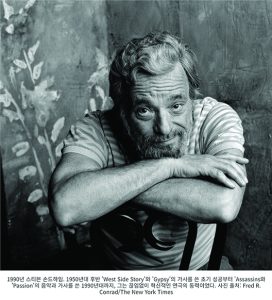
©Fred R.Conrad/The New York Times
위대한 음악극의 반열에 오르려면 다양한 시대에 걸친 의미를 지녀야 한다. 이 높은 기준을 통과하지 못한 작품으로는 ‘토스카’ ‘마술피리’ ‘방황하는 네덜란드인’ ‘파르지팔’ ‘팔스타프’ ‘장미의 기사’ ‘박쥐’ ‘사운드 오브 뮤직’과 앤드루 로이드 웨버(1948~)의 전작(全作)이 있다. 이 기준을 되레 높이는 작품도 있는데, ‘카르멘’ ‘트리스탄과 이졸데’ ‘살로메’ ‘예누파’ ‘피터 그라임스’ ‘웨스트 사이드 스토리’와 스티븐 손드하임(1930~2021)의 최소 절반, 혹은 최대 전작이 이에 해당한다.
최근 손드하임의 두 작품과 그에 대한 놀라운 전기는 고인의 변화무쌍한 재능을 확인시켜 준다. 손드하임 사후 새롭게 무대에 오른 리바이벌 중 하나인 영국 런던 브리지 시어터 ‘숲속으로’는 제빵사와 그의 아내가 저주를 피해 아이를 가지려 애쓰는 이야기를 이분법적 성 정체성에서 유동적인 성 정체성으로 변모시켜 그렸다. 둘 다 손드하임이 생전에 그린 바와는 다소 달랐지만, 그게 바로 이 작품의 강점이다.
해당 작품의 연출가인 조던 파인은 유대인 마을 배경의 뮤지컬 ‘지붕 위의 바이올린’에서 좌우익을 망라하는 가장 오래된 혐오이자, 되살아난 반유대주의를 그려내며 새롭게 접근한 바 있다. 파인의 갖은 노력에도 불구하고 ‘지붕 위의 바이올린’은 여전히 향수에 젖은 가벼운 작품으로 남은 반면, ‘숲속으로’는 끝없는 모호성으로 가득한 심연이 되었다.
마리아 프리드먼(1960~)의 영화 ‘메릴리 위 롤 얼롱’ 또한 이런 유동성을 공유한다. 프리드먼은 같은 목표를 품은 창작자 세 명의 이야기를 역순으로 풀어내며 순진한 이상주의를 걷어내고 관계의 성공과 실패를 바라보는 손드하임의 근원적 냉소주의를 보여준다. 세 인물 모두 잘못을 저질렀고, 후회는 날카로운 칼날처럼 서곡으로 이어진다. 작곡가는 셋 다 사랑하지 않았고, 어쩌면 모두를 증오한 것 같기도 하다. 충격적이라고? 정답이다.

브리지 시어터 ‘숲속으로’ ©Johan Persson
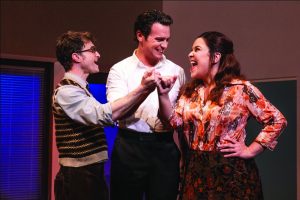
영화 ‘메릴리 위 롤 어롱’
미국 뮤지컬계의 전설이 만든 ‘파격’
손드하임의 모호성은 그가 스스로 끝내 풀리지 않을 것이라 여겼던 수수께끼를 파헤치며 눈가림과 궤변의 껍질을 벗겨내는 다니엘 오크렌트(1948~)의 신작 전기 (‘스티븐 손드하임: 예술은 쉽지 않다’)에서 낱낱이 공개되고 만다. 이 전기는 미국 예일대 출판부의 ‘유대인의 삶(Jewish Lives)’ 시리즈로 출판되었다. 가만, 유대인의 삶이라고? 손드하임은 어쩌다가 유대인으로 태어났을 뿐, 그 외에는 딱히 관련 없다고 주장했다. 뉴욕의 군사학교를 다녔던 그를 유대계 미국인 스승 오스카 해머스타인(1895~1960)이 브로드웨이로 이끌었고, 화성적 비건(편집자 주_전통적인 화성학 체계를 엄중히 따르는 성향을 일컫는 비유)이자 유대계 미국인인 밀턴 배빗(1916~2011)이 그에게 음렬주의를 가르쳤으며, 유대계 미국인 레너드 번스타인이 그를 잘나가는 무리에 끼워준 덕분에 1957년 ‘웨스트 사이드 스토리’가 세상에 나왔다. 그를 둘러싼 주된 세력은 유대인이고 그의 일상은 유대적이었다.
정확한 영문에 광적으로 집착했던 손드하임이었지만, 그의 서한에는 ‘Shiduch(중매)’ ‘Chazerei(쓰레기)’ ‘Pisher(애송이)’ ‘Shlepper(무능력자)’ ‘Kvetch(불평분자)’ 등 이디시어(편집자 주_유대인들이 사용해 온 게르만어파 계통의 언어)가 섞여 있곤 했다. 원작자 잉마르 베르그만에게 바치는 전원풍 작품 ‘소야곡’을 두고도 “빌어먹을 만치 비유대적이다”라고 일컬었다. 그는 리처드 로저스의 딸 메리 로저스와, 해럴드 프린스의 아내이자 자신의 ‘뮤즈’인 주디 프린스와 특히 가까운 우정을 유지했다. ‘메릴리 위 롤 얼롱’의 등장인물 ‘메리’에는 친구의 모습이 겹쳐 있다. 주디의 아버지는 이디시어 히트송 ‘내게 당신은 아름다워요(Bei Mir Bist Du Shayn)’를 작곡한 사울 채플린(1912~1997)이었다.
손드하임을 둘러싼 유대계 환경이 얼마나 긴밀했던지 레너드 번스타인과 같은 심리치료사에게 치료를 받을 정도였는데, 둘 다 밀턴 호로비츠 박사를 파티에 초대하기도 했다. 그는 번스타인 부부가 주최한 극좌파 ‘흑표범단’ 후원 파티에도 참석했는데, 톰 울프가 이 파티를 기록하며 신조어 ‘레디컬 시크(Radical Chic)’를 탄생시켰다. 손드하임은 “번스타인이 백날 자기 자랑만 하는 꼴에 열이 뻗친다”라며 못마땅해했다. 번스타인이 낡아 빠진 ‘웨스트 사이드 스토리’의 영광으로 연명할 동안, 손드하임은 다양한 작품 활동을 통해 미국 뮤지컬계를 부활시키기에 이른다.
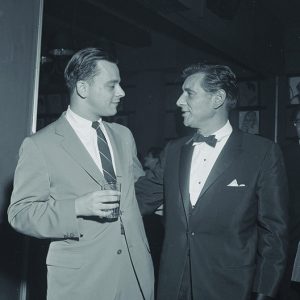
손드하임(좌)과 번스타인(우) ©Friedman Abeles_The New York Public Library for the Performing Arts
격식 뒤에 감춰져 있던 본모습
동성애자라는 정체성은 손드하임이 지닌 또 다른 수수께끼였다. 에이즈 관련 행사는 참석하지 않을 정도로 조심스러웠던 그는 동성애자들이 자주 가는 장소를 피했고, 고독을 해소하기 위해 이혼한 친구 메리 로저스에게 ‘위장 결혼’을 제안했다. 마침내 그가 한 남성과 동거를 한 것은 60대에 이르러서였지만, 사실 손드하임은 동성애자라는 정체성을 숨기지 못했으며 자녀가 없다는 후회도 감추지 못했다. 그의 말을 빌자면, “바흐도 아이를 두었는데, 나라고 왜 못했겠는가?”
자신의 모순을 극복하기 위해 손드하임은 고기능성 알코올 중독자가 되어 증류주 약 1리터를 몇 시간 만에 다 마시기에 이르렀다. 오크렌트는 그가 매일 마리화나를 피우고 때로는 코카인 흡입도 했다고 밝힌다. 직업적으로 보았을 때는 전혀 드러나지 않았던 사실이다. 일전에 손드하임을 가까이에서 세 번이나 만난 적이 있는데, 그는 술에 취하기는커녕 공손하고 호기심 많고 악의라고는 하나 없어 보였다. 내가 고도의 입담을 동원하고 나서야 그에게서 앤드루 로이드 웨버에 대한 다음의 뾰족한 한마디를 끌어낼 수 있을 정도였다. “저는 ‘투게더(together)’와 ‘포에버(forever)’의 운율이 맞는다고 생각하는 사람을 진지하게 받아들일 수 없습니다.”
나는 그가 보여준 격식이라는 껍데기에 속은 것이다. 오크렌트의 책은 평론가들을 향한 분노와 손드하임 친구들에 대한 앙심으로 출렁인다. 작가의 적대감이 집필 동기가 아닐까 싶은 정도다. 오크렌트는 뮤지컬 ‘컴퍼니’ ‘태평양 서곡’ ‘일요일 공원에서 조지와 함께’의 주인공들에게 경멸을 퍼붓기를 서슴지 않는데, 사실 마지막 작품은 손드하임의 예술가적 자화상이나 다름없다. 또한 오크렌트는 사람들의 목을 베고 인육 파이를 파는 행위에 대리 만족하는 스위니 토드의 복수에 흡족해하고 그 어마어마한 악행을 조안나에 대한 비통함과 수려한 가사로 포장한다. 말하자면 손드하임에게 ‘복수는 나의 것’이다. 그리고 그 복수는 문제를 자해의 칼날 끝까지 밀어붙인다.

‘숲속으로’ 중 ‘고통’

‘메릴리 위 롤 어롱’ 중 ‘하루도 빠짐없이’
그럼에도, 오선지에 남긴 희망의 씨앗
브로드웨이 극장가에서 손드하임은 관객을 기쁘게 하거나 귀갓길에 음을 흥얼거리게 하는 작곡가는 아니었다. ‘누구나 휘파람을 불 수 있지’의 역설은 손드하임 곡을 그 누구도, 심지어 작곡가 본인조차 휘파람으로 불 수 없다는 점에 있다. 나도 한 번 직접 그에게 불어보라고 부탁해 확인해봤다. 하지만 평생을 완벽하게 받아들여지지 못한 채 살았던 음악가의 내면에는 사랑받기를 갈구하던 한 남성이 있었다. 그가 만들어낸 무대 위의 난폭함은 사실 내가 어떤 사람이든 제발 나를 사랑해달라고 관객에게 보내는 호소였다.
굳이 덧붙이자면, 나는 이를 반유대주의에 대한 유대인의 전형적인 반응이라고 본다. 손드하임은 “전 세계와 연결되고 싶다”라는 가닿을 수 없는 희망을 이야기했다. ‘숲속으로’의 넘버 ‘고통(Agony)’이나, ‘메릴리 위 롤 얼롱’의 넘버 ‘하루도 빠짐없이(Not a Day Goes By)’ 같은 곡은 사람 간의 관계든 음표 간의 관계든 영원히 행복하기만 한 결말은 없다고 넌지시 말한다. 그러나 그는 우리의 삶이 변할 수 있다는 희망의 씨앗 또한 이 작품, 저 작품의 오선지 여기저기에 뿌려 놓았다.
번역 evener
Norman Lebrecht Column
노먼 레브레히트 칼럼의 영어 원문을 함께 제공합니다.
본 원고는 본지의 편집 방향과 일치하지 않을 수 있습니다.
The test of a great music drama is its capacity to feel relevant to varied times. Works that fail this high bar include Tosca, Magic Flute, Flying Dutchman, Parsifal, Falstaff, Rosenkavalier, Fledermaus, The Sound of Music and the complete works of Andrew Lloyd Webber. Those that keep raising the bar include Carmen, Tristan und Isolde, Salome, Jenufa, Peter Grimes, West Side Story and the complete works – well, at least half – of Stephen Sondheim.
Two recent Sondheim shows and a groundbreaking biography confirm his chameleon-like gift for validity. Into the Woods at London’s Bridge Theatre, the first posthumous Sondheim revival, had a baker and his wife flicker from binary to non-binary as they flee a curse and try to conceive a child. Neither is quite what Sondheim imagined, and that’s the strength of the piece.
Its director, Jordan Fein, came fresh from converting the shtetl caper ‘Fiddler on the Roof’ into a mirror on resurgent antisemitism, the oldest hatred now uniting left and right. Fiddler, for all Fein’s efforts, remains a nostalgic trifle. Into the Woods, by comparison, is a bottomless well-shaft of infinite ambiguities.
Maria Friedman’s film of Merrily We Roll Along shares its fluidity. Stripping out bright-eyed idealism from a backwards-told tale of three creatives with a common goal, Friedman exposes Sondheim’s fundamental cynicism about relationship success and failure. Each of the three characters is at fault. Regret is scored into the overture with a razor blade. The composer, one guesses, does not love any of the three; even hates them. Disturbing? You got it.
Sondheim’s ambiguities are laid bare in Daniel Okrent’s revelatory new biography, which peels back layers of sophistry and camouflage to expose an enigma that Sondheim thought he had left unbreakable. The book is published in Yale University’s Jewish Lives series. A Jewish life? Sondheim insisted he had none, other than an accident of birth. He attended military academy. Oscar Hammerstein, his mentor, took him down Broadway.
Milton Babbitt, a harmonic vegan, taught him serial technique. Leonard Bernstein drew him into the power-pack that in 1957 created West Side Story. His primary influences were Jews, his vernacular Jewish.
Fanatical about English precision, Sondheim littered his letters with Yiddishisms: shiduch (matchmaking), chazerei (piggishness), pisher, shlepper, kvetch. He referred to A Little Night Music, his Ingmar Bergman bucolic tribute, as ‘so damn goyish’. His best female friends were Mary Rodgers, Richard’s daughter, and Hal Prince’s wife, Judy, his ‘real-life Muse’. Mary is the pivotal character in Merrily. Judy Prince’s father was Saul Chaplin, who wrote the ultimate Yiddish hit song, ‘Bei Mir Bist Du Shayn’.
So tight was Sondheim’s Jewish environment that he shared a psychotherapist with Leonard Bernstein. Both invited Dr Milton Horowitz to their parties. Sondheim was present the night the Bernsteins hosted the Black Panthers, an occasion recorded by Tom Wolfe as Radical Chic. He soured on Bernstein for ‘just blowing his own trumpet and it always pissed me off.’ While Lenny lived off faded West Side Story laurels, Sondheim’s output diversified to the point where it is his oeuvre that breathed resurgence into the American stage musical.
Being gay was Sondheim’s other conundrum. Discreet to the point of shunning AIDS galas, he avoided gay haunts and proposed a marriage blanc with the divorced Mary Rodgers as an antidote to loneliness. Only in his 60s did he finally live with a man, yet he never hid his gay identity or quelled his regret at not having children. Bach could, he said: why not me?
To cope his contradictions he became a high-functioning alcoholic, capable of downing two pints of spirits in hours. Okrent reveals that he used marijuana every day and cocaine on occasion. None of this was visible professionally. I had three close encounter with Stephen Sondheim and found him sober, courteous, curious and altogether without malice. It took advanced dentistry skills on my part to extract a jagged comment on Andrew Lloyd Webber: ‘I don’t think I can take seriously a man who thinks ‘together’ rhymes with ‘forever’.’
I was fooled by his carapace of civility. Okrent’s book ripples with venom for critics and vituperations against his friends. I suspect his animus was motivational. He lavishes contempt on central characters in Company, Pacific Overtures, and Sunday in the Park with George, the last of which is his self-portrait as an artist. He takes satisfaction in Sweeney Todd’s revenge, a vicarious pleasure at the cutting of throats and the sale of human-flesh-pies, mitigating the unspeakable vileness with exquisite lyrics and an aching lament to ‘Johanna’. Vengeance is mine, says Stephen Sondheim, forcing the issue to the knife-edge of self-harm.
Along the entertainment arcade of the Great White Way, Sondheim was the one who did not write to please, or to be hummed on the way home. The paradox of Anyone Can Whistle is that no-one can whistle Sondheim, even himself (I once asked him to try). Yet inside a musician who felt perpetually half-understood lived a man who longed to be liked, whose acts of stage violence are actually an appeal to the audience to say, please love me, despite what I am.
Which, I need hardly add, is a classic Jewish response to antisemitism. Sondheim spoke of an unattainable wish ‘to feel connected to the rest of the world’. Songs like ‘Agony’ (Into the Woods) and ‘Not a Day Goes By’ (Merrily) imply that relations, between people or musical notes, cannot be resolved happily ever after. But here and there, between five lines of a stave, he offers an ember of hope that life on earth can change, from one performance to the next.
글 노먼 레브레히트
영국의 음악·문화 평론가이자 소설가. ‘텔레그래프‘지, ‘스탠더즈‘지 등 여러 매체에 기고해왔으며, 지금 이 순간에도 자신의 블로그(www.slippedisc.com)를 통해 음악계 뉴스를 발 빠르게 전한다